Unicode-native byte-level 1D-CNN for phishing URLs across six writing systems, with an honest reproduction of the paper: 0.9954 F1 on 7,199 held-out real URLs.
Visual evidence verification system for damage claims across cars, laptops, and packages, comparing submitted images against claim text, history, and evidence requirements.
Anti-proxy attendance platform with admin, teacher, and student dashboards, session management, notifications, reports, and face descriptor support for attendance verification.
Shipped production generative AI voice agents for customer engagement, lead generation and support.
What I did
Built end-to-end voice pipelines combining LLM reasoning, speech recognition and text-to-speech over WebRTC for low-latency, browser-native audio
Implemented multi-turn dialogue with context retention and agentic flows; cut latency with prompt engineering, streaming inference and real-time audio processing
Turned client requirements into AI features with product and design teams, iterating quickly on customer feedback
Clinical decision support from electronic health records, built with doctors and medical staff.
What I did
Translated clinicians' needs into AI features for outcome prediction and decision support
Built end-to-end ML pipelines on patient EHR data (cleaning, preprocessing, feature extraction) under strict data-privacy rules
Measured model predictions against clinician decisions and presented the agreement to hospital teams
Python
PyTorch
Scikit-learn
SHAP
Pandas
Research with numbers I can rerun
Multilingual phishing defence, and voice AI that people who speak Indic languages can afford.
0.9954F1
UniPhish on 7,199 held-out real-world URLs, measured in my 2026 reproduction of the paper.
UniPhish: Unicode-Native 1D-CNN for Multilingual Phishing URL Detection in Messaging Applications
Jeevith Gangadhar, Raunak Khandelwal, K. Shashank Reddy, Sudhina Kumar G. K., Hareesha K. S.. IEEE (under review), 2025
A byte-level 1D-CNN that reads every URL as UTF-8 bytes, so one model with a 256-token vocabulary covers Latin, Arabic, CJK, Devanagari, Hangul and mixed scripts. In 2026 I reproduced the paper end to end and published where it held and where it did not.
Two of the paper's claims did not reproduce: the parameter count, and that ASCII detectors are blind to non-Latin scripts. The rerun says so openly; the byte-level design earns its place on homoglyph robustness.
Reported in the paper: 98.7% macro-average accuracy across 6 script families; 98.9% macro-F1 with 0.43 ms prediction latency on CPU; 668× faster than Multilingual BERT at equal accuracy; 96.1% accuracy against Unicode homoglyph attacks; 4.2 MB compressed model for sub-1 ms mobile inference
Dataset: MultiPhishDB, a 487,523-URL multilingual benchmark (κ = 0.91)
Threat intel: Real-time hunting over Certificate Transparency logs, producing STIX 2.1 and TAXII 2.1 indicators mapped to MITRE ATT&CK
Affordable Multilingual Voice Agents: A Self-Hosted Architecture for Indic Languages
Jeevith Gangadhar, Dr. Nagaraj Naik. Manipal Institute of Technology, 2025
A self-hosted voice agent for Hindi, Tamil, Telugu, Kannada, Tulu and English with automatic language identification, built to cost a fraction of commercial voice APIs.
It also flags emotional distress, for the safety-critical calls a voice agent should never miss.
33rd worldwide in the admissions puzzle; the top 50 earn entry
Snipers CTF
1st
Offensive security and problem solving
CompFest CTF
1st
Practical security analysis and exploitation
BushBash CTF
2ndAustralian National University
Podium in a cybersecurity competition
IIIT Hyderabad Hackathon
Finalist
Voice AI agent for Apollo Hospitals: patient queries and appointments
IIT Roorkee Frontend Hackathon
Finalist
Sponsor-focused event website
MIT Manipal Hackathon
4th
iWitness, anonymous crime reporting
NASA Space Apps Challenge
Participant
Data visualisation and simulation on NASA datasets
LA Hacks
SelectedUCLA
Selected to compete
HackGT
SelectedGeorgia Tech
Selected to compete
Big Red Hacks
SelectedCornell University
Selected to compete
UCF Hackathon
SelectedUniversity of Central Florida
Selected to compete
Junction
SelectedFinland
Selected to compete
SinceAI
SelectedFinland
Selected to compete
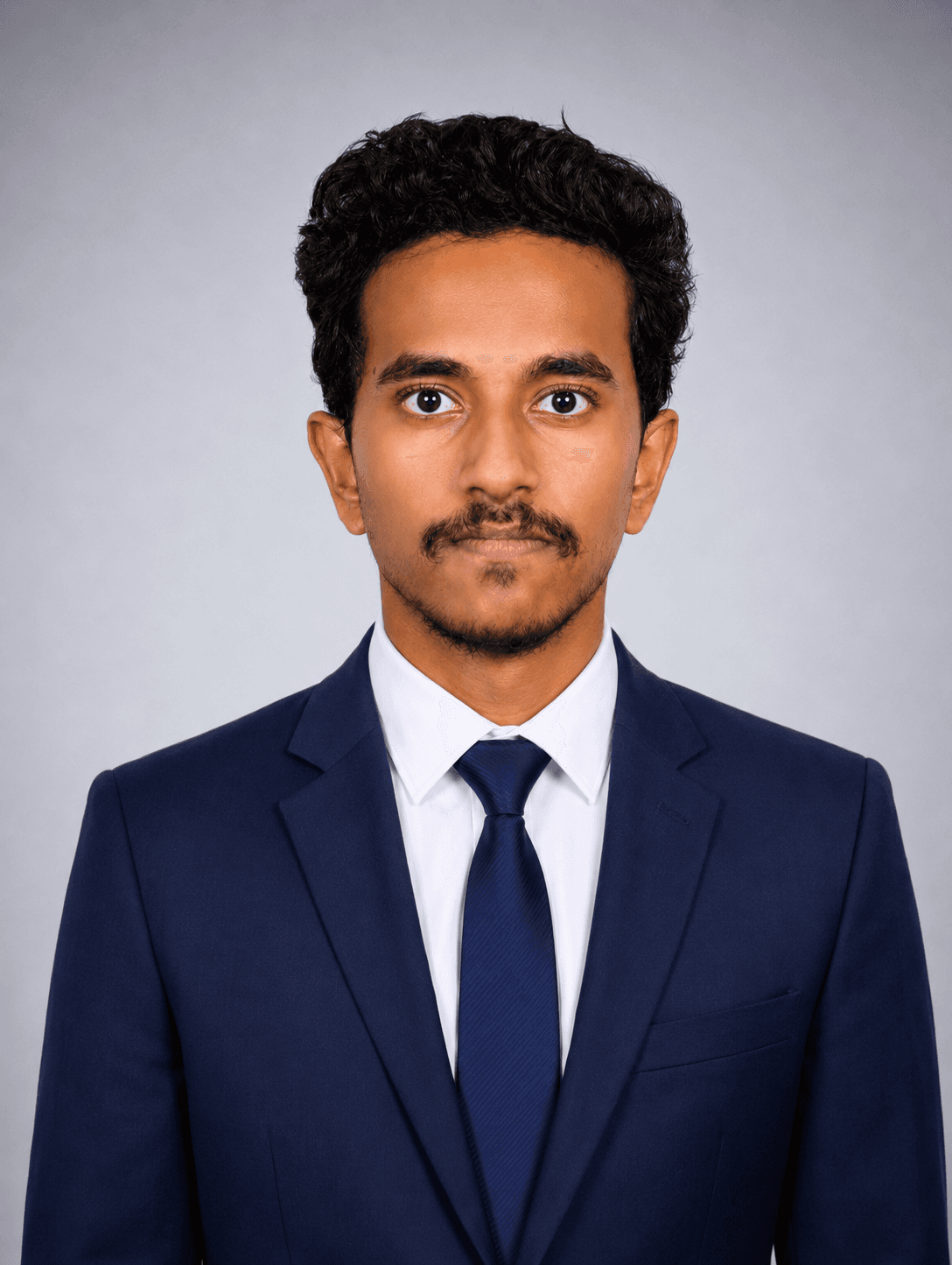
From Manipal to Hatfield
In 2026 I moved to the University of Hertfordshire for the final year of my Computer Science degree.
I build full-stack and backend systems end to end, then measure them: a platform grown to around 10,000 users, a 742 ms real-time voice pipeline, a phishing model that runs in 0.76 ms on a laptop CPU.
My first product, a university companion app, was acquired by Colcord, where I went on to lead the V1 platform. Since then I have built voice agents at VoiceDots, worked in Ericsson's Infrastructure and Network Security team, and built clinical ML with doctors at Kasturba Hospital.
My research is on UniPhish, multilingual phishing detection, and affordable multilingual voice agents for Indic languages. Outside coursework I play CTFs and build in the open.
I had a very long vacation after the completion of my course at ICAS Manipal, where this vacation was a complete roller coaster moment there were days where I s...
While building apps in this era where its been a norm just to vibe code the project using Claude or Codex, what I noticed is that not many people thinking about...